AI Implementation Gap: Why Marketing Agencies Pay for Tools They Never Use
9 mins read

There is a particular kind of frustration spreading through marketing agencies in 2026.
It starts when the managing director returns from a conference convinced that AI is going to transform the business. Subscriptions to ChatGPT, Jasper, and half a dozen other tools are purchased. A team meeting is held. Someone is assigned to "look into it." Three months later, the tools are still being paid for. Nobody is using them consistently. The conference energy has dissipated. And the managing director is starting to wonder if AI was overhyped after all.
It was not overhyped. The implementation just failed. And it failed in a way that is entirely predictable — and entirely preventable.
The numbers behind the gap
The scale of the AI implementation gap in marketing is striking when you look at the data directly.
According to Supermetrics' 2026 Marketing Data Report, based on a global survey of 435 marketing professionals, 80% of marketers feel pressure to adopt AI. Yet only 6% have fully implemented it in their workflows.
Read that again. Eight in ten agency professionals feel genuine urgency around AI adoption. One in seventeen has actually done it.
Separately, while 68% of marketers report using AI in some capacity, only 17% have received proper training on the tools they are using. The rest are improvising — using tools they do not fully understand, for workflows they have not redesigned, producing results that do not justify the subscription cost.
The implementation gap remains significant across the agency sector specifically: only 30% of agencies have fully integrated AI across the campaign lifecycle, according to IAB research.
The result is an industry where the majority of agencies are simultaneously convinced that AI matters and unable to make it work in practice. That gap — between conviction and execution — is where competitive advantage is being won and lost right now.
Why the gap exists: the three real blockers
The AI implementation gap is not a technology problem. The tools work. The problem is everything that surrounds the tools — the data infrastructure, the internal expertise, and the workflow design that determines whether a tool becomes useful or abandoned.
The Supermetrics 2026 data identifies the primary blockers clearly: 38% of marketing professionals cite a lack of in-house expertise, 30% say their technical stack is insufficient to support AI workloads, and 27% are uncertain about the business value AI can deliver in their specific context.
Each of these blockers looks different from the inside of an agency.
Blocker 1: No one owns the implementation
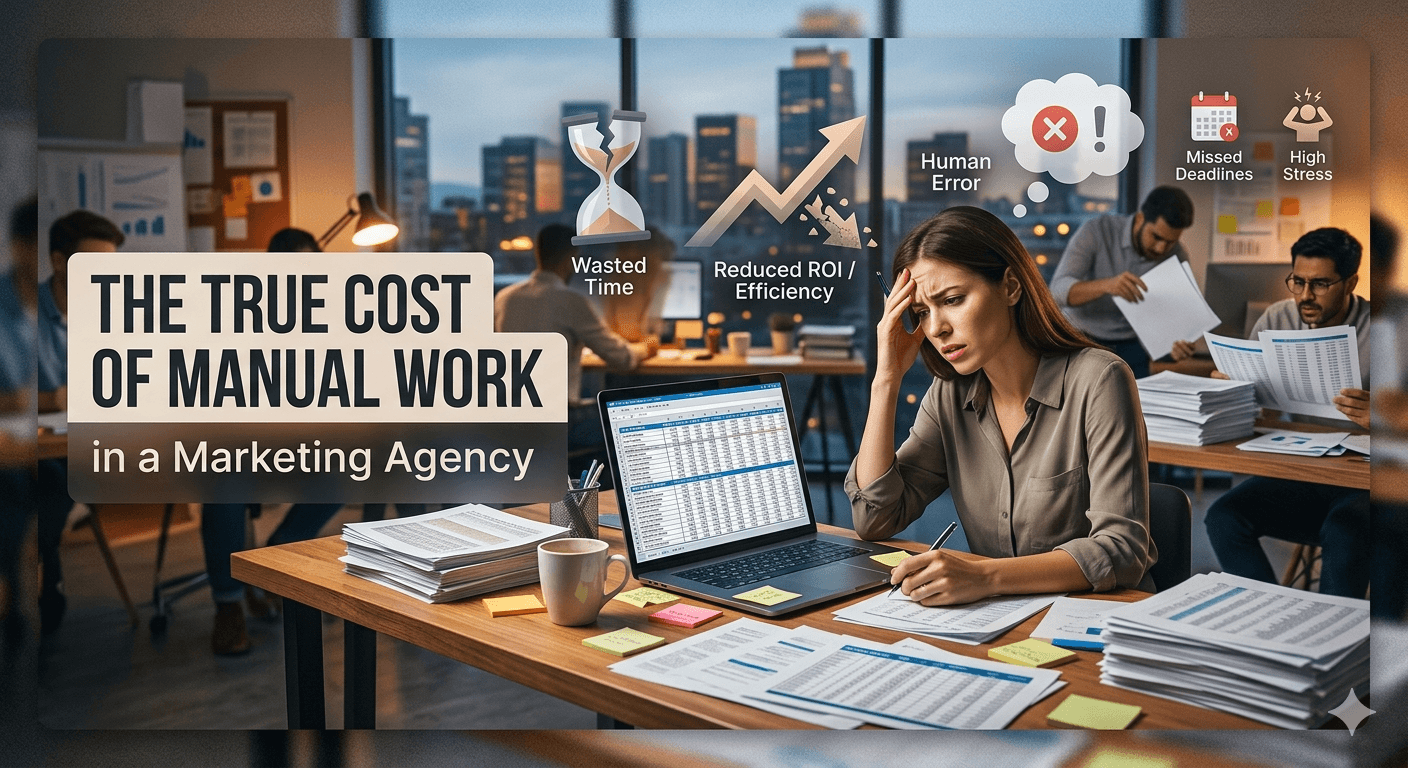
Buying an AI tool is a five-minute decision. Implementing it properly — connecting it to existing data sources, redesigning the workflow it is supposed to improve, training the team on how to use it, and building the measurement framework to track whether it is working — is a multi-week project.
Most agencies assign this project to someone who already has a full-time job. It gets started, stalled, and quietly abandoned. The subscription continues. The tool goes unused.
The agencies that have successfully implemented AI almost universally have one thing in common: someone with dedicated time and ownership of the implementation. Not a committee. Not a side project. One person responsible for making the tool work.
Blocker 2: The data foundation is not ready
The 2026 Marketing Data Report is direct on this point: AI cannot close the analytics gap without AI-ready data. When systems are not integrated and the data strategy sits outside marketing, AI cannot access clean, structured, decision-ready inputs.
In practical terms for a marketing agency, this means: if your client data lives across seven different platforms with no integration layer, an AI tool cannot meaningfully analyse it. The tool is only as good as the data it can access.
This is why so many agency AI projects stall at the pilot stage. The tool works in a demo environment with clean, structured data. It struggles in the real environment where the data is fragmented, inconsistent, and spread across platforms that do not talk to each other.
Blocker 3: The use case is too broad
"We want to use AI to improve efficiency" is not a use case. It is a direction. Directions do not get implemented — specific, scoped workflows do.
Most AI experiments are happening in silos, driven by excitement and enthusiasm rather than a defined use case or a connected data model. And that creates a massive expectation versus adoption gap.
The agencies that have closed the implementation gap did not start by trying to transform everything at once. They identified the single most expensive, most repetitive workflow in their operation and automated that one first. Only after that workflow was running reliably did they expand to the next one.
What successful AI implementation actually looks like
The 6% of agencies that have fully implemented AI did not do anything magical. They followed a pattern that is visible in almost every successful case.
They started with a specific problem, not a general ambition.
Not "we want to use AI to be more efficient" but "we want to eliminate the 25 hours per week our team spends building client reports manually." The specificity matters because it defines success clearly. Either the reports are being generated automatically or they are not. There is no ambiguity.
They connected the data first.
Before building any automation, they ensured the relevant data — GA4 metrics, ad platform performance, CRM data — was accessible and standardised in one place. This foundation work is unglamorous. It is also what makes everything else possible.
They bought outcomes, not tools.
The uncomfortable truth about AI tools for agencies is that most lists focus on which tools exist rather than which tools actually work for agency workflows. The agencies that succeeded were not searching for the best AI tool. They were searching for a system that solved a specific problem — and they evaluated options based on whether the problem got solved, not on feature lists or user interface aesthetics.
They measured from day one.
Only 19% of organisations track KPIs for generative AI. Despite widespread adoption, measurement gaps persist. The agencies that justify and expand their AI investment are the ones tracking hours saved, output volume, error rates, and client satisfaction before and after implementation. Without measurement, there is no case for continuing the investment — and no way to identify what is working.
The compounding cost of not closing the gap
The agencies that have not yet solved the implementation problem are not simply in the same position they were in two years ago. They are falling behind at an accelerating rate.
Marketing teams using AI strategically already see 44% productivity gains and save an average of 11 hours per week. An agency operating with those productivity gains and competing against one that is not has a structural cost advantage that compounds every month.
Consider what 11 hours per week per account manager means at scale. For an agency with five account managers, that is 55 hours per week — the equivalent of a full-time employee — redirected from repetitive execution to strategic and creative work. Or, looked at differently, the capacity to serve significantly more clients without increasing headcount.
Marketing teams that implement AI automation report being able to bring campaigns to market up to 75% faster, and can reallocate up to 30% of their working time from repetitive execution toward strategy and creative work.
The agencies capturing that advantage are not doing so by working harder or hiring more people. They have changed the system.
The specific workflows where agencies are closing the gap
Not all agency workflows are equally good candidates for AI automation. The best candidates share three characteristics: they are high-frequency (happening weekly or daily), they are data-driven (involving the collection and formatting of information rather than creative judgment), and they are currently consuming significant team time.
The workflows that consistently meet these criteria across agencies are:
Client reporting. Weekly performance reports across GA4, Google Ads, and Meta remain one of the highest-time-cost workflows in most agencies. Automating data collection, report generation, and client delivery eliminates the largest single block of repetitive work most account managers face.
Lead qualification and follow-up. Inbound leads that sit uncontacted for more than five minutes have significantly lower conversion rates. AI qualification systems score leads immediately, send personalised first-touch messages, and book discovery calls automatically — without any human involvement in the first stage of the process.
Content production at scale. Agencies producing content for multiple clients find that the brief-to-draft stage can be heavily automated. One structured brief can generate a week of social posts, email copy, and ad variations — which a human then reviews and refines rather than writes from scratch.
Competitive intelligence monitoring. Weekly automated reports on competitor activity — pricing changes, new content, ad spend signals, job postings — give account managers contextual insight without the manual monitoring that currently consumes hours.
In each case, the pattern is the same: a high-frequency, data-driven workflow is automated end-to-end, and the human's role shifts from doing the work to reviewing and acting on it.
Why pre-built systems outperform DIY automation
The majority of agencies that have attempted to build their own AI workflows have encountered a predictable problem: the system works until something changes.
GA4 updates its data model. Meta changes its API endpoints. A new version of the automation platform introduces breaking changes. The system that took three weeks to build stops working, and no one has time to fix it. The project is abandoned. The subscriptions are cancelled. The managing director concludes that AI is not ready for agency use.
This is not a failure of AI. It is a failure of build strategy.
The alternative — buying a pre-configured system that is maintained by specialists as the underlying tools evolve — solves this problem directly. The agency gets the output (automated reports, qualified leads, scheduled content) without the infrastructure responsibility. When GA4 updates its API, the system gets updated. The report still arrives in the client's inbox on Monday morning.
This is the model that is enabling agencies to finally close the implementation gap without creating a new technical liability in the process.
Closing the gap: what to do this week
The agencies still sitting in the 94% who have not fully implemented AI are not necessarily behind because they lack ambition or capability. Most are behind because the path from "we should do this" to "it is running reliably" has been unclear.
That path has three steps:
Step 1: Identify your single most expensive repetitive workflow. Calculate the actual hours per week it consumes across your team. Multiply by your blended hourly rate. That number is the annual cost of not automating it.
Step 2: Find or build a system that automates that specific workflow end-to-end. Not a tool — a complete system that connects your data sources, generates the output, and delivers it without manual intervention.
Step 3: Run it alongside your existing process for two weeks. Confirm the outputs match what you would have produced manually. Then switch fully, and redirect those hours to higher-value work.
The implementation gap is not a technology gap. The technology exists, works reliably, and is accessible to agencies of any size. It is an execution gap — and execution gaps close one workflow at a time.
How Jazasync helps agencies close the implementation gap
Jazasync builds and deploys pre-configured AI systems for marketing agencies — fully connected, tested across real client environments, and maintained on a subscription basis so they keep working as the underlying tools evolve.
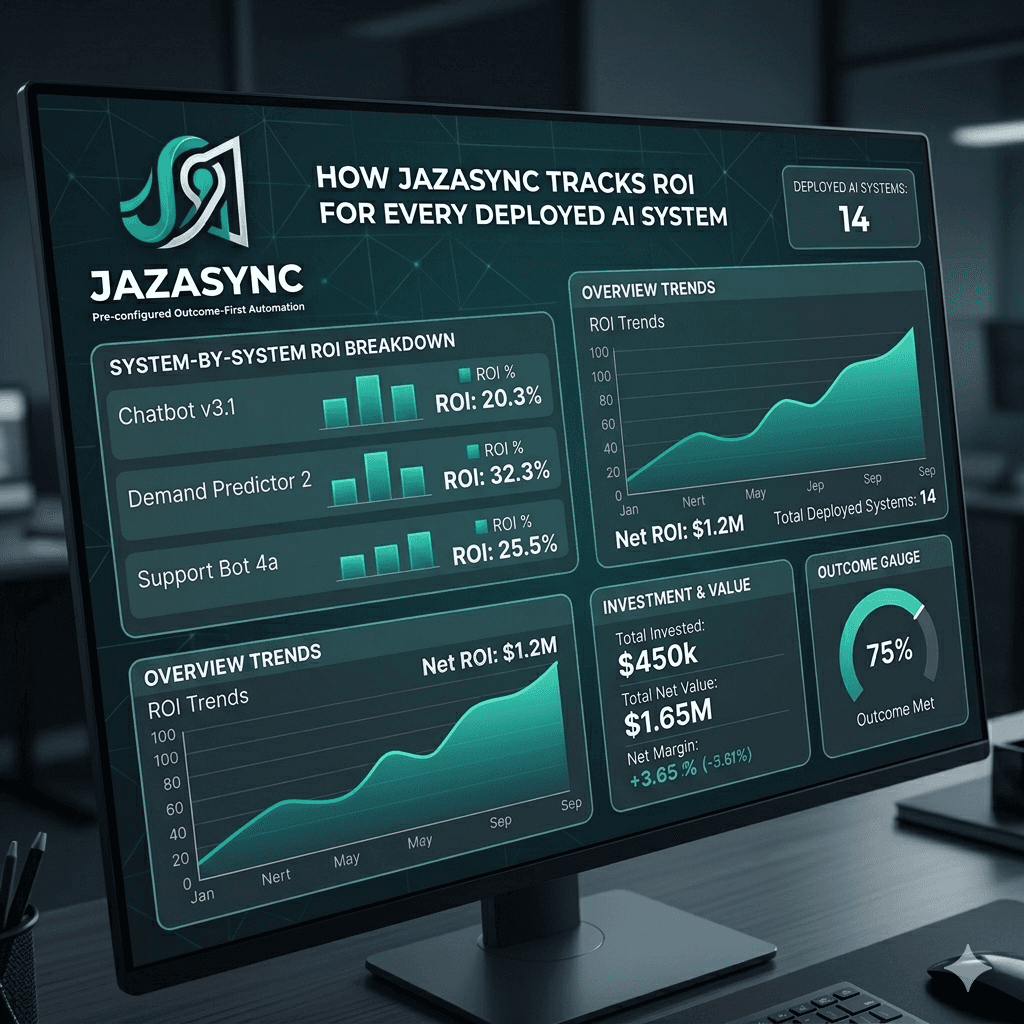
Every deployed system connects to Nexus, our client operations dashboard, which tracks hours saved, value generated, and system health in real time. You see the ROI from day one.
Book a free 20-minute AI audit → We will review your current workflows, identify the highest-impact automation opportunity in your agency, and show you exactly what a deployed system would look like.
Arsalan Waseem is the founder of Jazasync, a productized AI systems company building and deploying automation workflows for marketing agencies.
Tags: AI Implementation · Marketing Agency Automation · Agency Operations · AI Tools 2026 · Workflow Automation
Related articles:
How marketing agencies are automating client reporting in 2026
What is Nexus? How Jazasync tracks ROI for every deployed AI system
More