True Cost of Manual Work in a Marketing Agency (And How to Calculate Yours)
10 mins read
Ask any agency owner how much manual work costs their business, and you will get one of two answers.
The first is a shrug. They know it costs something, but they have never calculated it properly. The second is a number — and it is almost always too low, because it only counts the obvious costs and misses the ones hiding in plain sight.
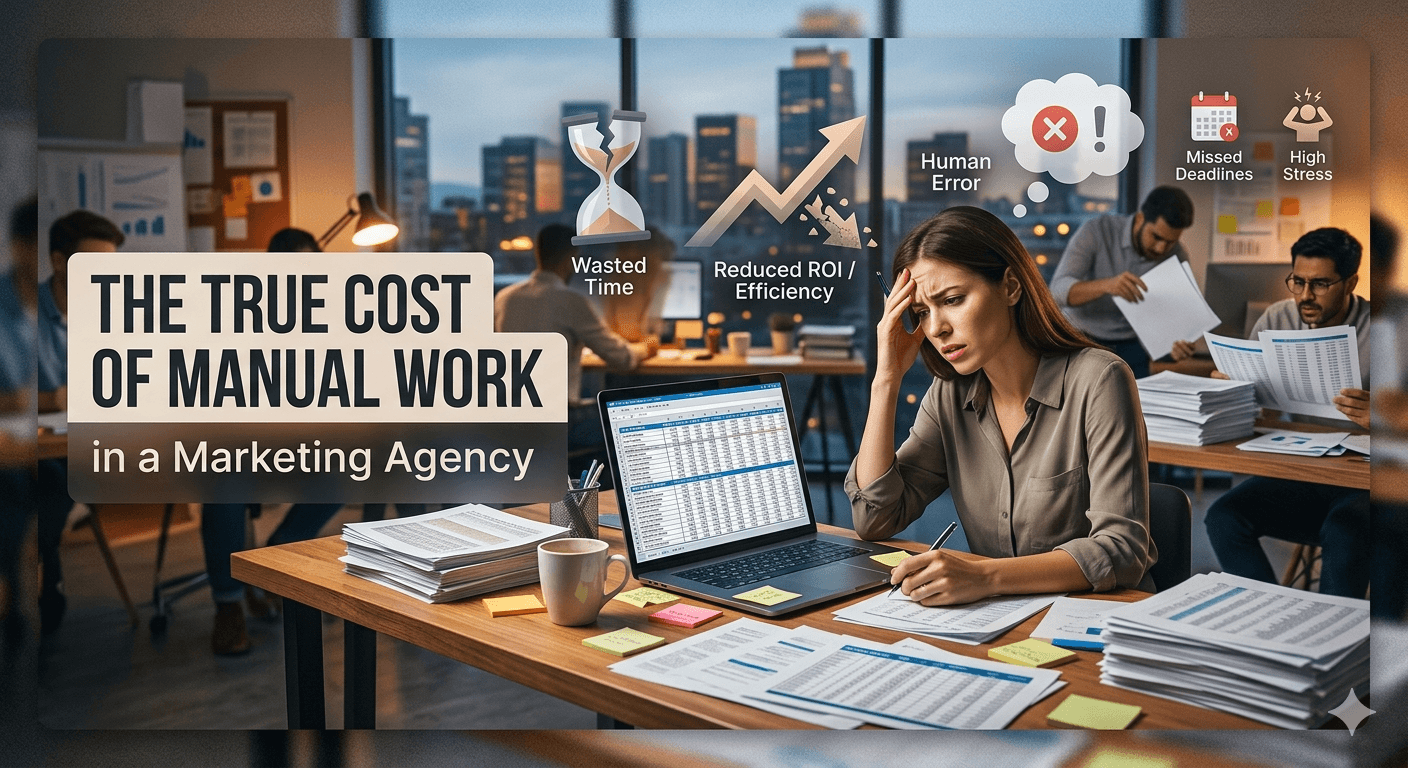
The true cost of manual work in a marketing agency is not just the hours spent doing the task. It is the billable hours that did not happen because a team member was building a report. It is the client that churned because the reporting felt inconsistent. It is the strategic work that never got done because execution consumed the week.
This article will show you how to calculate the true cost precisely — and what the agencies that have fixed this problem actually did about it.
Why most agencies underestimate the cost
The standard way agencies think about manual work costs goes like this: count the hours, multiply by the salary cost, arrive at a number. That number feels uncomfortable. Then the next client email arrives and the calculation gets forgotten.
The problem with this approach is that it only captures the direct cost — the salary equivalent of time spent on repetitive tasks. It misses three categories of cost that are often larger than the direct cost itself.
The billable hour gap. Research from agency benchmarking data shows that manual time entry alone records only 67% of actual billed work — meaning agencies are systematically under-billing for the time their teams are spending. But beyond billing accuracy, every hour a team member spends on manual execution is an hour they are not spending on billable strategic work. For a senior account manager billing at £100/hour, one hour of manual reporting is not a £35 cost (their salary equivalent). It is a £100 cost — the billable revenue that hour could have generated.
The capacity ceiling. Manual workflows cap how many clients one account manager can serve effectively. The industry standard is 4–6 clients per account manager when reporting, content, and lead follow-up are handled manually. Agencies running automated workflows consistently report managing 8–12 clients per account manager with the same or better output quality. The capacity gap between those two numbers represents the revenue your agency is leaving on the table every month — not because you lack clients, but because your team lacks the capacity to serve more of them.
The error cost. Manual data entry across multiple platforms introduces errors that carry downstream consequences. A transposed number in a client report leads to a strategy conversation based on wrong data. A missed lead follow-up because no one checked the inbox on Friday afternoon means a prospect goes cold. These costs are invisible in any standard accounting of manual work — but they show up in client retention and pipeline conversion rates.
The manual work cost calculator
The following framework will give you an accurate picture of what manual work is costing your agency annually. Work through each section using your real numbers.
Section 1: Client reporting
Step 1: How many clients does your agency currently report to on a weekly or monthly basis?
Example: 12 clients
Step 2: How long does it take to produce one report manually, from data collection to delivery? Count every step: logging into platforms, pulling data, formatting the document, writing the summary, sending the email.
Example: 2.5 hours per report
Step 3: How frequently are reports produced per client per month?
Example: 4 weekly reports = 4 per month
Step 4: Multiply: clients × hours per report × reports per month × 12 months.
Example: 12 × 2.5 × 4 × 12 = 1,440 hours per year spent on client reporting
Step 5: Multiply total hours by your blended hourly rate (salary cost, not billing rate).
Example: 1,440 hours × £35/hour = £50,400 per year in salary cost
Step 6: Now calculate the billable revenue that time could have generated. Multiply total hours by your average billing rate.
Example: 1,440 hours × £85/hour = £122,400 per year in potential billable revenue
The gap between £50,400 (what you are paying) and £122,400 (what those hours could generate) is the true opportunity cost of manual reporting for a 12-client agency.
For context: a typical small agency managing 8 Google Ads clients spends 240 hours and the equivalent of $19,200 per year purely on mechanical data copying — and that is only one platform, for one report type, for monthly reporting. The number compounds dramatically when you account for all platforms and weekly reporting cycles.
Section 2: Content production
Step 1: How many clients do you produce content for per week?
Example: 8 clients
Step 2: How many hours per client per week does content production take, from brief to scheduled post?
Example: 3 hours per client
Step 3: Multiply: clients × hours × 52 weeks.
Example: 8 × 3 × 52 = 1,248 hours per year on content production
Step 4: Multiply by blended hourly rate.
Example: 1,248 × £35 = £43,680 per year
Section 3: Lead qualification and follow-up
Step 1: How many inbound leads does your agency receive per week?
Example: 15 leads
Step 2: How long does manual lead qualification and first-touch follow-up take per lead?
Example: 20 minutes per lead
Step 3: Multiply: leads per week × minutes × 52 weeks ÷ 60.
Example: 15 × 20 × 52 ÷ 60 = 260 hours per year on lead qualification
Step 4: Multiply by blended hourly rate.
Example: 260 × £35 = £9,100 per year
Section 4: Admin and time tracking
Research from agency benchmarking data is direct on this point: manual time entry costs 5–7 hours per employee per month. For a team of five, that is 25–35 hours per month — 300–420 hours per year — spent on administrative work that generates no output.
Step 1: Number of team members who manually track time or handle admin.
Example: 5 team members
Step 2: Hours per month per team member on admin tasks.
Example: 6 hours
Step 3: Multiply: team members × hours per month × 12.
Example: 5 × 6 × 12 = 360 hours per year on admin
Step 4: Multiply by blended hourly rate.
Example: 360 × £35 = £12,600 per year
The total
Workflow | Hours/Year | Salary Cost | Billable Opportunity Cost |
|---|---|---|---|
Client reporting | 1,440 | £50,400 | £122,400 |
Content production | 1,248 | £43,680 | £106,080 |
Lead qualification | 260 | £9,100 | £22,100 |
Admin and time tracking | 360 | £12,600 | £30,600 |
Total | 3,308 | £115,780 | £281,180 |
For an agency matching these parameters — 12 reporting clients, 8 content clients, 15 leads per week, 5 team members — the true cost of manual work is not £115,780. It is £281,180 per year in potential revenue that is being consumed by tasks that could be automated.
That is the number that tends to change how agency owners think about automation.
Where the cost hides in plain sight
Beyond the calculator, there are three places manual work costs that most agency benchmarking frameworks miss entirely.
The client retention cost
Inconsistent reporting is one of the leading causes of client churn in agency relationships. When a report arrives late, is formatted differently to last month's, or contains a data error, the client's confidence in the agency erodes. That erosion is gradual and invisible — it does not appear on any spreadsheet — until the client gives notice.
The average cost of losing and replacing a client — including the time spent on the exit process, the lost revenue during the gap, and the cost of acquiring a replacement — is typically three to five times the monthly retainer value. A client paying £3,000/month who churns because of reporting inconsistency costs the agency £9,000–£15,000 in real terms.
Automated reporting eliminates the inconsistency entirely. Every report arrives on the same day, in the same format, with accurate data from the same sources. The client's experience of being well-served becomes a function of the system, not of whether the account manager had a busy week.
The strategic capacity cost
The most expensive form of manual work is not the time it consumes. It is the strategic thinking it displaces.
An account manager who spends 10 hours per week on reporting, content formatting, and lead follow-up has 10 fewer hours for the work that actually differentiates your agency: audience research, campaign strategy, creative ideation, client relationship development. This strategic work is not just more valuable to the client — it is the work that justifies premium pricing, drives referrals, and builds the agency's reputation.
Agencies that have automated their execution workflows report a consistent shift in how their teams experience their work. The account manager who used to dread Monday reporting is now doing the thing they were hired to do. That shift matters for retention of your best people — not just retention of your clients.
The compounding competitive gap
Every month your agency is spending 1,440 hours on manual reporting, a competitor who has automated that workflow is spending 120 hours reviewing reports and 1,320 hours on strategic and creative work. That gap compounds. After twelve months, the competitor has invested the equivalent of 8.25 additional full-time months into strategy, creative, and business development — while your team was formatting spreadsheets.
This is the cost that does not appear in any single month's accounts but shows up after two or three years in the form of a competitor with better case studies, more client referrals, and a stronger market position.
The workflows worth automating first
Not every manual workflow has the same ROI from automation. The highest-value candidates share three characteristics: they are high-frequency, they are data-driven rather than creative, and they consume disproportionate senior team time.
Based on the calculator framework above, the priority order for most agencies looks like this:
1. Client reporting — the highest time cost and the highest impact on client retention. Automating this single workflow typically recovers more hours than any other change an agency can make.
2. Lead qualification and follow-up — the highest revenue impact. Every lead that goes cold because follow-up was delayed is direct pipeline loss. Automation ensures every lead receives a personalised response within minutes, regardless of what the rest of the team is doing.
3. Content production — the highest volume cost. Producing content for multiple clients at scale is where manual work compounds fastest. Automating the brief-to-draft stage, even partially, has an outsized impact on team capacity.
4. Admin and time tracking — the least visible cost and often the easiest to address. Automated time tracking and project management integrations recover the 5–7 hours per employee per month that currently disappears into administrative overhead.
What the agencies that have fixed this did differently
The agencies that have successfully automated their manual workflows did not do it by purchasing more tools. Most of them already had more tools than they needed.
What they did differently was approach automation as a system problem, not a tool problem. The question they asked was not "which AI tool should we use?" but "which specific workflow is costing us the most, and what does a complete solution to that workflow look like — from data input to final output, with no manual steps in between?"
That framing produces a different outcome. Instead of a subscription to a platform that requires significant setup and configuration, it produces a deployed, running system that solves a specific problem from day one.
The distinction matters because the implementation gap — the gap between buying a tool and having a working system — is where most agency AI projects fail. The tool exists. The workflow redesign, the data connections, the testing, and the ongoing maintenance are what most agencies do not have the time or expertise to build themselves.
The agencies recovering the most from manual work costs in 2026 are the ones that recognised this and bought deployed systems rather than raw tools.
Calculating your own number
Work through the calculator in this article using your real numbers. The result will be uncomfortable — it almost always is. But it is also clarifying.
The question it answers is not "should we automate?" The data on that question is unambiguous. The question it answers is "what is the cost of not automating?" — and having that number makes every subsequent decision about where to invest in automation straightforward.
How Jazasync approaches this
At Jazasync, we deploy pre-configured AI systems that eliminate the highest-cost manual workflows in marketing agencies — starting with client reporting, lead qualification, and content production.
Every system we deploy is fully connected to your existing data sources, tested across real client environments, and maintained on subscription so it keeps running as the underlying tools evolve. The setup takes under five business days. The hours come back immediately.
Book a free 20-minute AI audit → We will work through the cost calculator with you using your real numbers, identify the highest-impact workflow to automate first, and show you exactly what a deployed system would deliver for your agency.
Arsalan Waseem is the founder of Jazasync, a productized AI systems company building and deploying automation workflows for marketing agencies.
Tags: Agency Efficiency · Marketing Agency Automation · Manual Work Cost · AI for Agencies · Agency Operations 2026
Related articles:
How marketing agencies are automating client reporting in 2026
The AI implementation gap: why agencies pay for tools they never use
What is Nexus? How Jazasync tracks ROI for every deployed AI system
More