What Is Nexus? How Jazasync Tracks ROI for Every Deployed AI System
8 mins read
Here is a problem most agencies do not talk about openly.
They implement an AI tool. They spend time setting it up, or pay someone else to set it up. The tool starts running. And then — nothing. No measurement. No before-and-after comparison. No way to know whether the tool is saving 10 hours a week or two hours a week or any hours at all.
Only 19% of organisations track KPIs specifically for the AI tools they are using. The rest are running AI workflows without any framework to measure whether those workflows are delivering value. They know the tool is doing something. They do not know if that something is worth what they are paying for it.
This is the measurement gap — and it is the reason so many AI implementations quietly fail. Not because the technology stops working, but because without measurement, no one can prove it is working. And what cannot be proven cannot be defended when the next budget conversation comes around.
Nexus is Jazasync's answer to this problem.
What Nexus is
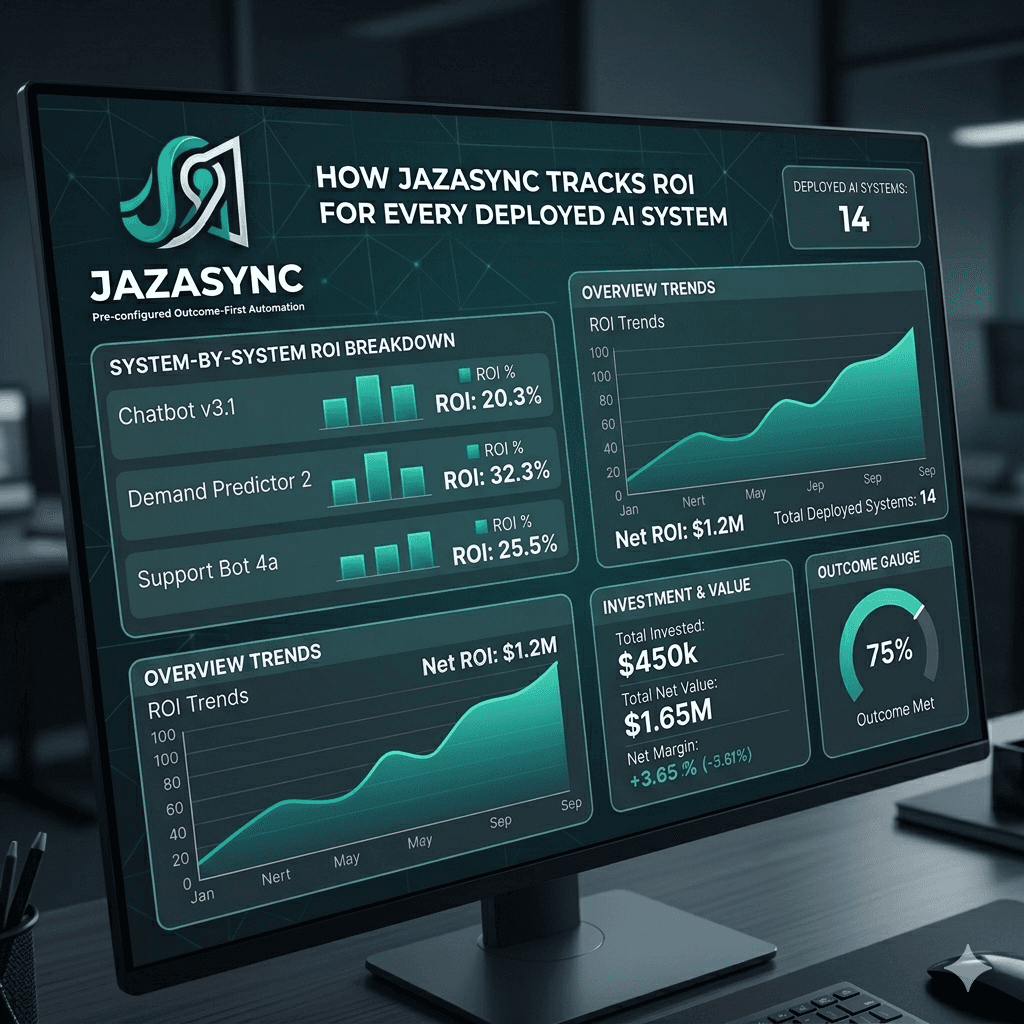
Nexus is the client-facing operations dashboard that comes with every Jazasync AI system deployment. It is the place where the impact of every running automation becomes visible — in real time, automatically, without anyone manually pulling data or building reports.
Every agency that deploys a Jazasync system gets access to Nexus from day one. It is not an optional add-on. It is not a separate product. It is the measurement and visibility layer that makes every deployed system accountable.
The core principle behind Nexus is straightforward: if you cannot see what an AI system is doing, you cannot trust it. And if you cannot trust it, you will not renew it. Nexus makes trust visible.
What Nexus tracks
Nexus tracks three categories of data across every deployed system.
Performance metrics
For each active AI system, Nexus shows the primary output metric in real time. For the Client Reporting Automator, that metric is reports sent. For the Agency Content Engine, it is content pieces generated. For the AI Lead Qualifier, it is leads qualified and meetings booked.
These metrics accumulate daily. Over time, they build into a performance record that shows not just what the system did today but what it has done across its entire deployment — total output generated since launch, week-over-week trends, and any anomalies that suggest something may need attention.
Hours saved
Every Jazasync system is calibrated with a time-per-unit figure based on how long the equivalent manual task takes a human. The Client Reporting Automator, for example, is calibrated at 2.5 hours saved per report sent — based on the actual time agencies spend collecting data, formatting the report, and sending it manually.
As the system runs and logs output, Nexus calculates hours saved automatically. An agency running the Client Reporting Automator for ten clients across twelve weeks does not need to estimate the time saving. Nexus has been counting.
Value generated
Total AI ROI is calculated as revenue gains plus cost savings plus retention benefits plus operational efficiencies, minus total AI costs. Nexus applies a simplified version of this calculation in real time, using a conservative hourly rate of £75 per hour as the baseline value of recovered agency time.
Hours saved multiplied by £75 gives the estimated value generated by each system since deployment. This number is visible on the dashboard at all times and is included in the automated monthly ROI report that Nexus sends to every client.
The result is that an agency reviewing their Nexus dashboard after 90 days does not need to estimate whether their AI investment was worthwhile. The number is there. It is calculated from real output data. And it is almost always significantly larger than the cost of the system.
Why measurement matters more than the automation itself
91% of marketing leaders agree that AI takes too long to implement, and 75% say it takes too long to optimise. A significant part of that frustration comes not from the technology itself but from the inability to see clearly what is working.
When AI systems run without measurement, three things tend to happen.
The value becomes invisible. The automation runs in the background. No one is calculating the hours it is saving or the output it is generating. The tool becomes a line item that is easy to cut when budgets tighten — not because it stopped working, but because no one built the case for keeping it.
Problems go unnoticed. Without a dashboard monitoring system health, a broken connection or an API change that interrupts the automation can go undetected for weeks. The system stops logging output. No one notices until a client asks why their report has not arrived.
Expansion decisions become guesswork. An agency that does not know the precise ROI of its first AI system has no reliable basis for deciding whether to invest in a second one. The decision becomes a feeling rather than a calculation.
Nexus addresses all three of these problems directly. Value is visible at all times. System health is monitored automatically, with alerts triggered if any system goes dark for more than 72 hours. And the cumulative ROI data from one system becomes the business case for the next.
The Nexus dashboard: what you actually see
When an agency owner logs into Nexus, they land on the dashboard page. It shows:
This month's performance — a summary panel with three headline figures: active systems running, total hours saved in the last 30 days, and total value generated in the last 30 days. These are the numbers that answer the question "is this worth it?" in under five seconds.
Active systems — a card for each deployed Jazasync system showing the system name, current health status (Healthy / Needs Attention / Offline), the primary output metric, and the date of last activity.
Open support tickets — any active requests submitted to the Jazasync support team, with status and expected resolution.
From the dashboard, clients navigate to deeper views. The Performance page shows line charts for daily output, hours saved, and value generated across the last 30 days. The My Systems page shows a full table of all deployed systems with maintenance dates and historical performance. The Support page allows clients to submit requests directly, which route to the Jazasync support team and are tracked through to resolution.
The monthly ROI email
Once a month, Nexus automatically generates and sends a ROI summary email to every active client. The email contains:
Total output generated across all systems in the past 30 days
Total hours saved in the past 30 days
Total estimated value generated in the past 30 days
A comparison to the previous month (up or down, and by how much)
System health status for each active deployment
A note on any updates applied to systems during the month
The email takes no time to produce — it is generated automatically from the data Nexus has been collecting. It arrives in the client's inbox on the first Monday of each month, whether or not anyone at Jazasync has touched anything over the weekend.
This email is the single most important retention tool in the Jazasync model. Clients who see their ROI summary every 30 days — who see the hours saved accumulating and the value generated compounding — do not cancel their subscriptions. They ask what the next system should be.
How Nexus creates switching costs that protect the relationship
There is a strategic reason Nexus is built into every Jazasync deployment from day one, not added later.
Integrating data from CRM, ad performance, and customer interactions into a unified dashboard provides clarity and makes it easier for decision-makers to visualise outcomes and buy into future investments.
Every month that a client uses Nexus, their performance history deepens. After six months of deployment, an agency has six months of granular data on exactly what their AI systems have produced, how many hours those systems have saved, and what the cumulative value of that time amounts to.
That data lives in Nexus. It is the client's data — they own the insight. But it is stored and structured within the platform. An agency considering switching providers after six months is not just switching their AI systems. They are walking away from six months of performance history, trend data, and ROI calculations that they use to justify their technology spend internally and to their own clients.
This is not a lock-in trap. It is a natural consequence of a platform that is genuinely useful. The more an agency uses Nexus, the more valuable the historical data becomes — and the more visible the switching cost.
Nexus and the path to a single AI operations platform
Nexus is currently in its first version — and it is already the most sophisticated visibility layer available for deployed AI systems in the agency market. But it is also the foundation for something larger.
The roadmap for Nexus over the next 18 months includes team access (multiple logins per agency account so the whole team has visibility), a configuration editor (clients can adjust system parameters without submitting a support ticket), and self-serve system activation (agencies browse the full Jazasync library and activate new systems directly from within Nexus).
When those features are live, Nexus becomes the interface through which agencies manage their entire AI operations stack — not just the systems Jazasync has deployed, but the full picture of where AI is running in their business and what it is producing.
Reporting automation delivers a 341% return on investment in year one — making it one of the highest-confidence starting points for any marketing team beginning their AI implementation journey. Nexus makes that ROI visible from the first week of deployment.
What Nexus means for the agency owner
For an agency owner who has tried AI tools before and found them hard to justify, Nexus changes the equation fundamentally.
The question is no longer "I think this is saving time, but I am not sure how much." It is "Nexus shows we have saved 340 hours and £25,500 in the past 90 days. What should we automate next?"
That is a different conversation. It is a conversation about expansion, not justification. And it is the conversation that every Jazasync client is having by the end of their first quarter of deployment.
Getting started with Nexus
Nexus access is included with every Jazasync system deployment — there is no additional cost and no separate sign-up. From the moment a system goes live, Nexus begins tracking output, calculating hours saved, and building the ROI record that will make the next technology decision obvious.
Book a free 20-minute AI audit → We will review your agency's current AI workflows, identify the highest-impact system to deploy first, and show you exactly what your Nexus dashboard will look like after 90 days of operation.
Arsalan Waseem is the founder of Jazasync, a productized AI systems company building and deploying automation workflows for marketing agencies.
Tags: AI ROI Tracking · Nexus · Agency AI Dashboard · Marketing Agency Automation · AI Operations 2026
Related articles:
How marketing agencies are automating client reporting in 2026
The AI implementation gap: why agencies pay for tools they never use
More