How Marketing Agencies Are Automating Client Reporting in 2026
8 mins read

Every Monday morning, the same ritual plays out across thousands of marketing agencies worldwide.
Someone opens five browser tabs — Google Analytics, Meta Ads Manager, Google Ads, a spreadsheet, and a PowerPoint. They spend the next two to three hours manually pulling numbers, copying them into columns, formatting charts, writing summaries, and sending a report that the client will spend approximately 90 seconds reading before asking: "But are the ads actually working?"
Only 14% of agency marketers have extensively automated their data integration and report generation. The rest are losing hundreds of hours every month to manual formatting.
That gap — between the 14% who have automated and the 86% who haven't — is exactly where the competitive advantage sits in 2026.
The real cost of manual client reporting
Before we talk about automation, it helps to understand what manual reporting is actually costing your agency.
For a mid-sized agency managing 10 clients, a conservative estimate looks like this:
2.5 hours per client report, per week
10 clients = 25 hours per week
25 hours at a £75/hour blended rate = £1,875 per week in unbillable labour
£97,500 per year spent on a task that generates zero additional revenue
That number tends to focus minds.
And that's before accounting for the errors. Manual data entry across five platforms means numbers get transposed, date ranges get mismatched, and the wrong campaign gets credited. Manual reporting relies heavily on human effort, which introduces inconsistencies and potential data misinterpretations.
The agencies that have solved this problem didn't hire faster data entry specialists. They removed the human from the reporting loop entirely.
What automated client reporting actually looks like in 2026
Automated client reporting is not a dashboard your client logs into and ignores. That is the old version of the idea — and it mostly failed because clients do not want to pull their own data. They want the insight delivered to them, formatted correctly, with context.
The modern version works like this:
1. Data is pulled automatically from every source
Your reporting system connects directly to GA4, Google Ads, Meta Ads Manager, LinkedIn Campaign Manager, and any other platform your client runs campaigns on. Every week — or every day, if the client needs it — the system pulls fresh data without anyone logging in manually.
2. A branded PDF report is generated automatically
The data populates a pre-designed template with your agency's branding, your client's logo, and the specific metrics they care about. The report looks identical every week — clean, professional, consistent — because no human touched it.
3. The report is emailed to the client automatically
At 8am on Monday, the client receives their weekly performance report. No one at your agency had to do anything. The report arrived because the system is running.
4. Your team reviews the insight, not the data
This is the shift that matters most. Your team is no longer spending time collecting data. They are spending time interpreting it — identifying what to optimise, what to test next, what story to tell the client in the monthly strategy call. Reporting automation takes reporting from 6 hours per client down to 20 minutes. Those hours go back to billable work.
The tools agencies are using to automate reporting in 2026
The automation stack for client reporting has matured significantly. Agencies are building their systems across three layers:
The data layer
This is where raw performance data lives and is standardised. The most common tools here are Google Analytics 4 (GA4) for web performance, Meta Ads Manager for Facebook and Instagram campaigns, and Google Ads for search and display. These are the sources — the pipes that carry the data.
The automation layer
This is the engine that connects everything together. Make.com and Zapier remain essential in 2026 to integrate CRMs, ad platforms, project management tools, and niche solutions into one automated ecosystem. Make.com in particular has become the preferred choice for agencies building more complex, multi-step automations — it offers significantly more flexibility than Zapier for conditional logic and data transformation.
The intelligence layer
This is where AI enters the picture. Tools built on the Claude API or similar large language models sit between the raw data and the final report. They do not just format numbers — they interpret them. An AI layer can write a plain-English summary of why conversions dropped last week, flag an anomaly in the cost-per-click data, and suggest what the account manager should discuss on the next client call. This is what separates a 2026 automated report from the automated dashboards of 2020.
The delivery layer
Buffer handles scheduled social content. ConvertKit or similar tools handle the email delivery of reports. For PDF generation, tools like Make.com can trigger a PDF build from a Google Doc template and send it directly to the client via email — no human in the loop.
The implementation gap: why most agencies haven't done this yet
If automated reporting is so clearly better, why are 86% of agencies still doing it manually?
Agencies that aren't using analytics to prove ROI to their clients are the ones with the shortest client lifespans. The research is unambiguous. And yet the adoption rate remains low.
The reason comes down to three barriers:
Barrier 1: Setup complexity
Connecting GA4, Meta, and Google Ads to an automation layer, building a report template, configuring the PDF generation, and scheduling the email delivery is not a one-afternoon project. For an agency owner who is already billing 50 hours a week, finding the time to build the system is the first problem.
Barrier 2: Maintenance anxiety
What happens when GA4 updates its API? What happens when Meta changes its data export format? Agencies that have tried to build their own systems often find that the system breaks within 90 days and no one has time to fix it. This is why so many automation projects get abandoned.
Barrier 3: The "good enough" trap
Manual reporting feels familiar. It takes time, but it works. The cost is invisible because it hides inside salary costs and unbillable hours rather than showing up as a line item. Agencies underestimate what manual reporting is actually costing them until they calculate it properly.
How agencies are solving the implementation gap in 2026
The shift in 2026 is away from agencies trying to build these systems themselves and toward buying pre-built, deployed systems from specialists.
The difference is significant. Building a reporting automation from scratch requires connecting APIs, configuring data transformations, building report templates, testing edge cases, and maintaining the system when underlying tools change. For most agency owners, that is not a core competency — and it should not be.
Pre-built reporting systems come fully configured, tested across multiple client environments, and maintained on a subscription basis. When GA4 updates its API, the system gets updated. When a new version of Make.com introduces a better way to handle the data transformation, the system gets updated. The agency owner does not need to know any of this is happening. The report arrives in the client's inbox on Monday morning regardless.
This is the model that allows one account manager to strategically oversee 8–12 clients instead of the industry standard of 4–6. The capacity doubles not because the account manager works harder but because the system handles everything that does not require human judgment.
What a fully automated client reporting system delivers
For an agency that has made the shift, the weekly reporting workflow looks like this:
Monday 8am — Every client receives their branded weekly performance report automatically. No one at the agency has done anything.
Monday 9am — The account manager reviews the reports, identifies the two or three insights worth discussing, and prepares for client calls. They are reading reports, not building them.
Rest of the week — The system continues to monitor performance. If a metric crosses a threshold (cost-per-lead exceeds the target, conversion rate drops below the baseline), an alert fires automatically. The account manager investigates the anomaly — not because they were manually checking dashboards, but because the system flagged it.
End of month — The client receives an automated monthly summary with trend analysis, period-over-period comparisons, and an AI-generated insight section. The account manager adds a strategic commentary in 20 minutes. The full document looks like it took half a day to produce.
The client's experience: they feel exceptionally well-served. Reports arrive consistently, on time, with clear data and genuine insight. They do not know — and do not need to know — that the data collection and formatting happened automatically.
The ROI of automated client reporting
The numbers on automated client reporting are straightforward to calculate.
For an agency managing 10 clients, spending an average of 2.5 hours per client per week on reporting:
Metric | Manual | Automated |
|---|---|---|
Weekly reporting hours | 25 hours | 2 hours (review only) |
Hours saved per week | — | 23 hours |
Billable value recovered (£75/hr) | — | £1,725/week |
Annual value recovered | — | £89,700 |
Monthly system cost | — | £200–£450/month |
Annual ROI | — | £87,000+ |
The system pays for itself within the first week of operation. Every subsequent week is pure recovery of time that was previously lost.
Getting started: what the path looks like
For agencies considering automated client reporting in 2026, the most important first step is not choosing a tool. It is identifying the single highest-cost reporting workflow in your current operation and automating that one first.
For most agencies, that is weekly campaign performance reporting across GA4, Google Ads, and Meta. That is the report that takes the longest, requires the most manual data collection, and is sent to the most clients.
Build or buy a system that automates that one report. Run it alongside your manual process for two weeks to confirm the numbers match. Then switch fully to the automated system and redirect those hours to client strategy.
The agencies saving 8 or more hours per week on reporting did not do it by optimising their spreadsheets. They changed the system entirely. The technology to do this — reliably, at agency scale, with proper maintenance — exists today and is accessible to agencies of any size.
The only question is how many more Mondays you want to spend building reports manually.
How Jazasync approaches automated client reporting
At Jazasync, we build and deploy the Client Reporting Automator as a pre-configured system for marketing agencies. It connects directly to GA4, Google Ads, and Meta Ads, generates a branded PDF report for each client, and delivers it automatically every week — with zero manual input from your team.
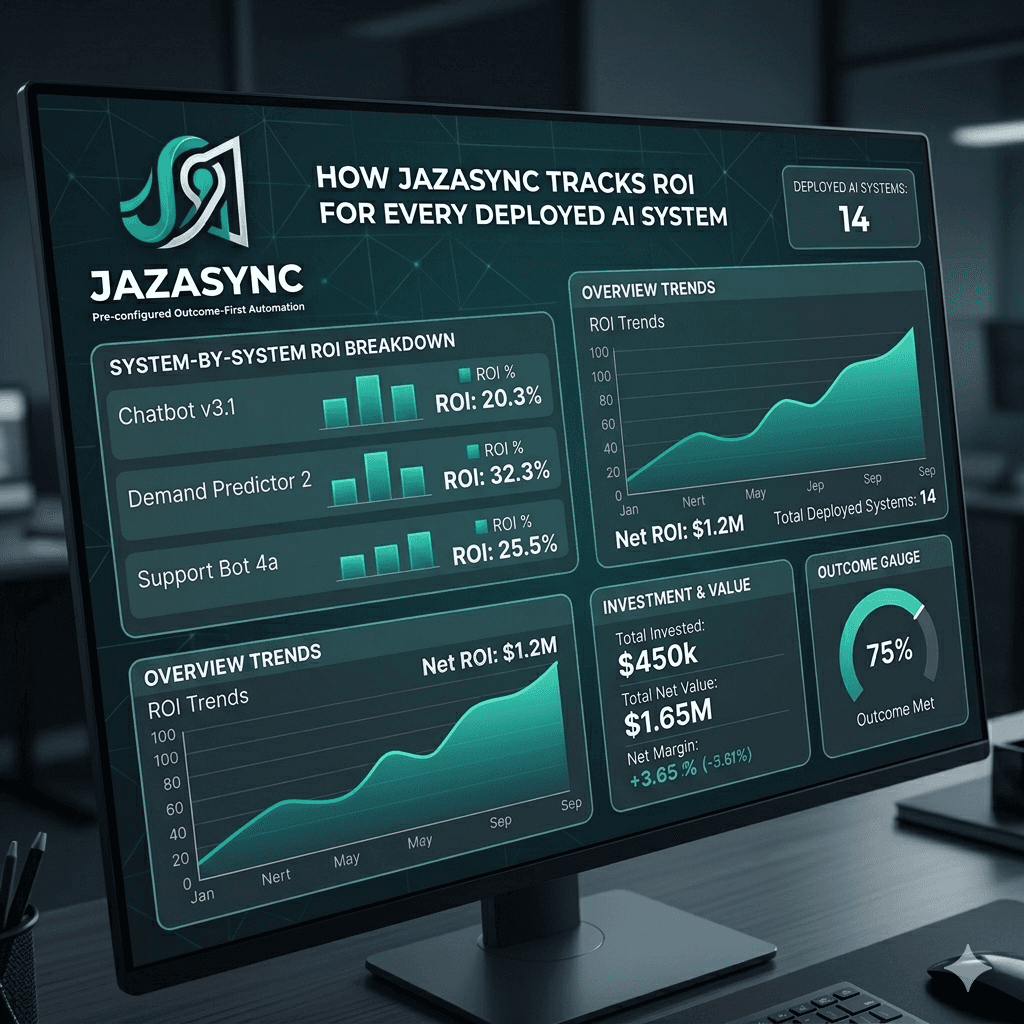
Every system we deploy includes access to Nexus, our client operations dashboard, which tracks hours saved, value generated, and system health in real time.
Book a free 20-minute AI audit → We will review your current reporting workflow and show you exactly what automation would look like for your agency.
Arsalan Waseem is the founder of Jazasync, a productized AI systems company building and deploying automation workflows for marketing agencies.
Tags: Automated Client Reporting · Marketing Agency Automation · AI for Agencies · Reporting Tools 2026 · Agency Operations
Related articles:
The AI implementation gap: why agencies pay for tools they never use
What is Nexus? How Jazasync tracks ROI for every deployed AI system
More